Articles by "Blog"
Showing posts with label Blog. Show all posts
This website is for all those who love to know about Pahari and wish to learn Pahari languages.

Kamaksha devi temple Karsog valley

The temple of Kamaksha devi (Goddess) is situated in district Mandi near Karsog valley at village Kao.

Karsog is a great beautiful valley near Shimla and Mandi. It is mainly popular for its temples, nature and local culture. Day by day this place is becoming popular and attraction of tourist. In Karsog valley there are too many orchards of apples and dense trees of deodars and pines.


The valley is having facilities like hotels, restaurants, roads and Transport. The distance of this village from main station karsog is about 7 km. The temple of Kamaksha Devi is dedicated to Goddess Durga. It is supposed by the villagers that Goddess durga trounced Demon Mahishasur (a demon in the form of a buffalo) here.

The temple looks very attarctive and beautiful having some great pieces of wooden art which is rarely found build by local villagers.

It has astonishing woodcarvings of Pagoda style structural design and there is also beautiful sights around the temple. Around the temple you will see some of the ancient time things which are really beautiful.


This website is for all those who love to know about Pahari and wish to learn Pahari languages.
Kalpa Kalpa is a little known town situated in the lap of the mighty 19965 feet Kinner Kailash peak, around 240kms from Shimla. Situated at an altitude of 9711 feet, Kalpa is surrounded by snowy peak for almost the whole year. One gets a clear view of the sacred Kinner Kailash peak as well as its sister peaks. You can get a chance to bike to this place, band in the middle of winters! Kalpa used be to a favourite haunt of Lord Dalhousie, who used to visit this place by travelling next to the Sutluj River in those days.


But nowadays you can easily drive down, although the road is quite tough! From Delhi, Shimla is a comfortable 9hour drive (355kms via Ambala and then NH22). From Shimla, things get interesting. Carry on the NH22 to Narkanda (64kms, an easy 2hr drive), then Rampur (another 73kms, 2 hours). From here on, for a while roads are good but mostly, turn into a bad shape with work going on (the hydro electric power station). But the views make up for it. From Rampur, you pass thru Jeori (23kms), Wangtu (37kms) and finally Karcham (20kms).

The road from Wangtu to Karcham is in a bad state and occasionally the road is blocked for a couple of hours due to landslide. At Karcham, a right goes to Sangla valley, take a left towards Recong Peo/Kalpa (35kms). At Recong Peo, there are two options, a longer 13kms or a shorter steeper 7km route. You can take another shorter 7km route, riding between apple orchads, narrow roads, in complete isolation. And if you are here between Dec and Feb, you will be greeted with atleast 5-6 frozen waterfalls by the road between Peo and Kalpa.

If you are driving youself, taking a nights stop at Narkanda, around 420kms, 11 hours from delhi. Stay at Himachal Tourism's hotel , Hotel Hattu. 180 degree view of the 18000-20000 feet peaks from Kalpa will keep you occupied for days. If you a
This website is for all those who love to know about Pahari and wish to learn Pahari languages.
The Tara Devi Temple has located at a distance of 11 km from Shimla on the Shimla – Kalka National Highway. The temple is dedicated to Goddess Tara and stands on Tara Devi hilltop between Shimla and Shoghi and is a very popular visiting spot for tourists and devotees.

The temple was built over 250 years ago and holds a great spiritual value for devotees. There is a belief that Goddess Tara was brought to Himachal Pradesh all the way from Bengal. It is believed that a king from the Sen Dynasty had a locket which contained a small gold idol of his family deity, Goddess Tara.

He visited this area over a hundred years ago wearing the locket tied around his upper arm. The idol remained encompassed and passed on through the many generations of the Sen Dynasty. But during the 96th generation dynasty, King Bhupendra Sen had an unusual vision near the current location of the temple, while he had been hunting, of his family deity Tara Devi along with her Dwarpal Bhairav and Hanuman Ji, expressing the need to be unveiled before the people, to bless and be prayed to. He, at once donated around 10 acres of land and had a temple constructed there to honor “Ma Tara” and her wishes.

A wooden idol of the goddess was installed and later on another king from the same dynasty, Raja Balbir Sen had another vision of the deity expressing her desire to be installed on the Tarav Parvat, and to honor her wishes he had another idol of Tara Devi made of Ashtadhatu, in his capital of Junga and carried it on an elephant “Shankar” to the hill top and had it installed in the 1825.

 The main attraction of the temple is it seclusion from the normal noise and pollution, traffic of the cities and towns. The Tara Devi Temple has tranquility and a sense of peace and relaxation in its atmosphere because of how its located away from everything, standing alone and serene. There are big precessions and celebration held at the temple during the Navaratras and Ashtami. To one side of the Temple you can see the beautifully snow-capped Himalayas and the town of Shimla while on the other side you can see the tremendously green and beautiful plains that spread out vastly between the mountains.


 There are two ways to get to the temple. You can both walk the 4 km distance from the national highway and enjoy the peaceful view and the scenery of the mountains while walking and for those of you not used to walking or have difficulty, you can drive from Shoghi, which is 6 kms from the temple. There are various taxis and transportation available from here and you can go up to as close as 200 meters near the temple, after which it’s a short walk to the Tara Devi Temple.

 Best time to visit  The best time to visit the Tara Devi Temple is during the Shardiya Navaratras and Ashthami which takes place during Dussehra, when there are big celebrations held in honor of Goddess Tara. A fair is organized during this time, and people from all over the country come to pray and pay their respects to the goddess. Tara Devi Temple is fit to visit all year round except for the rainy season between July and August. December and January aren’t ideal either because the snow fall makes it difficult to trek up or drive up to the temple. Trivia There is a “langar” held at the temple where food is distributed amongst the people on Sundays. There is a huge fair held at the temple during the Navrataras and Ashthami.

Timing The timing to visit the Tara Devi Temple is between 7:00 am and 6:30 pm.
This website is for all those who love to know about Pahari and wish to learn Pahari languages.

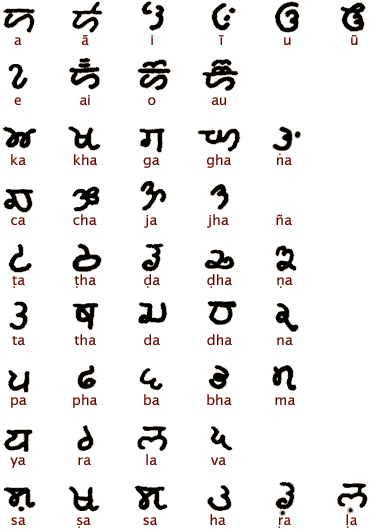
Takri script - A Script used to write Himachali languages

The Takri script (sometimes called Tankri) is an abugida writing system of the Brahmic family of scripts. It is closely related to, and derived from, the Sharada script employed by Kashmiri. It is also related to the Gurmukhī script used to write Punjabi. Until the late 1940s, And adapted version script of Takri (called Dogri, Dogra or Dogra Akkhar) was the official script for writing the Dogri in the state of Jammu and Kashmir and Kangri, Cahmbeali, Mandeali in Himachal Pradesh. There are some record of using Takri script in the history of Nepali (Khas Kura).

Takri has historically been used by a number of Western Pahari, Garhwali and Dardic languages in the Western Himalayas, such as Gaddi or Gaddki (the language of the Gaddi ethnic group), Kashtwari (the dialect centered on the Kashtwar or Kishtwar region of Jammu and Kashmir) and Chamiyali (the language of the Chamba region of Himachal Pradesh). Takri used to be most prevalent script for business records and communication in various parts of Himachal Pradesh including Chintpurni, Una, Kangra, Bilaspur and Hamirpur regions. The aged businessmen can still be found using Takri in these areas, but newer generation has now shifted to Devanagari and even English (Roman). This shift can be traced to have happened during the period ranging from 1950s to 1980s.

Takri Alphabets

Takri Vowel

This website is for all those who love to know about Pahari and wish to learn Pahari languages.
There are a dozen Western Pahari languages, of which Dogri and Kangri are the best known. Though traditionally considered Pahari, and often Hindi or Punjabi, the Western Pahari languages are more closely related to each other than to other Indo-Aryan languages. 17-20% of Jammu and Kashmir's population speaks Pahari languages. Pahari, along with Urdu, are the two most spoken languages in Kashmir.

The Western Pahari or Himachali languages are a range of languages and dialects spoken in the western parts of the Himalayan range, in northeastern Pakistan and the state of Himachal Pradesh, India.

Some Western Pahari languages, notably Dogri and Kangri, are tonal, like their close relative Punjabi but unlike most other Indic languages. Dogri has been an official language in India since 2003.
Although traditionally called Western Pahari, they are not as close to the other Pahari languages as they are to Punjabi. They are a dialect chain, and neighboring varieties may be mutually intelligible.

  • Pothwari (Also referred to as Pahari-Pothwari or Poonchi in Poonch and Rajouri districts)
  • Dogri
  • Kangri
  • Mandeali and various Chambealic varieties
  • Jaunsari
  • Kullu
  • Harijan Kinnauri
  • Hinduri
  • Mahasu Pahari
  • Sirmauri
Some Western Pahari languages have occasionally been regarded as dialects of either Urdu or Punjabi.

Script

Before the independence of India, many dialects of Himachali languages in Himachal Pradesh used to be written in the Takri script. Since it fell into disuse after independence, many efforts have been made to revive the Takri script for Himachali language.

Read Also : Takri script is used to write Himachali languages
This website is for all those who love to know about Pahari and wish to learn Pahari languages.
Pahari languages (Devanagari: पहाड़ी, pahāṛī 'of the hills') or Pahadi languages (Nepali: पहाडी) are a geographic group of Indo-Aryan languages spoken in the lower ranges of the Himalayas, from Nepal in the east, through the Indian states of Uttarakhand, and Himachal Pradesh.

The Pahari languages fall into three genealogical groups. Eastern and Central Pahari have been placed together as the Northern zone of Indo-Aryan, with Western Pahari in the Northwestern zone along with Punjabi and related languages.

Central Pahari

  • Kumaoni is spoken by an estimated 2,360,000 people in Uttarakhand.
  • Garhwali is spoken by an estimated 2,900,000 people in Uttarakhand. Most of these are Garhwali people from the state's northwestern division of Garhwal.

Eastern Pahari

  • Jumli is spoken by an estimated 40,000 people in the Karnali zone of Nepal.
  • Nepali is spoken by an estimated 11,100,000 people in Nepal, 265,000 people in Bhutan, and 2,500,000 people in India. It is an official language in Nepal and India.
  • Palpa is spoken by an estimated 7,500 people in the Lumbini zone of Nepal.

Western Pahari

There are a dozen Western Pahari languages, of which Dogri and Kangri are the best known. Though traditionally considered Pahari, and often Hindi or Punjabi, the Western Pahari languages are more closely related to each other than to other Indo-Aryan languages. 17-20% of Jammu and Kashmir's population speaks Pahari languages. Pahari, along with Urdu, are the two most spoken languages in Kashmir.
Read Also: Different types of Western Pahari languages


Language Group Region
Nepali Eastern
Pahari
Nepali is a lingua franca of Nepal, the Indian state of Sikkim and the Gorkhaland
region of West Bengal. It is also widely spoken in Northeast region of India and
also in Uttarakhand and Uttar Pradesh.
Kumaoni or Kumauni Central
Pahari
spoken in Kumaon region of Uttarakhand and Mahakali Zone of Nepal
Garhwali Central
Pahari
spoken in the Garhwal region of Uttarakhand
Himachali Western
Pahari
Kangri is spoken in the Kangra, Chamba, Bilaspur, Una, Mandi, Hamirpur districts
of Himachal Pradesh and the Gurdaspur, Hoshiarpur districts of Punjab
Dogri Western
Pahari
Dogri has official status in Jammu and Kashmir